 MADE IN USA



Why UV Prints Last: Understanding the Science of Long-Term Durability
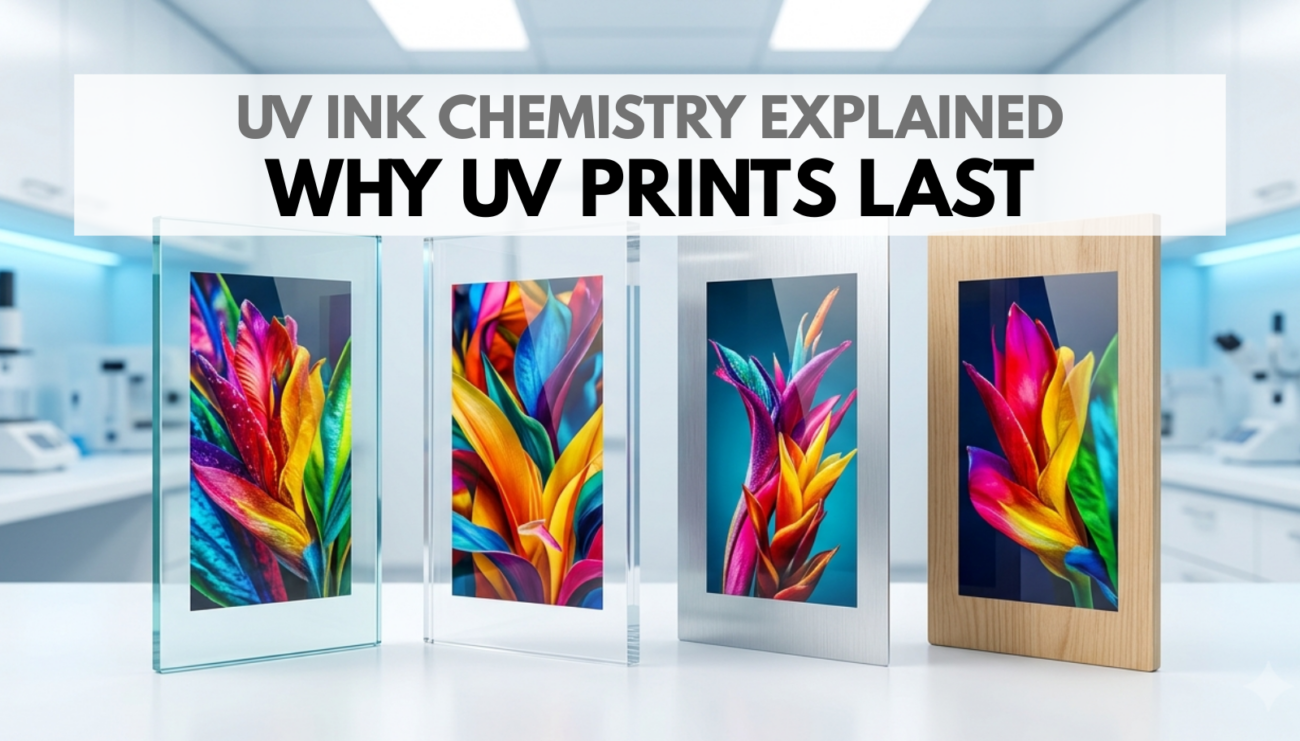
At first glance, one of the first things people notice about UV printing is how durable the finished print feels. Unlike many traditional printing methods, UV prints are often resistant to scratches, moisture and everyday handling almost immediately after curing. Regardless of whether the graphic is applied to acrylic, metal, wood, glass or plastic, properly cured UV ink creates a strong, long-lasting image that performs well in demanding environments. However, durability doesn't happen by accident. In fact, the same chemistry that allows UV ink to cure in seconds also creates a protective polymer structure that helps the printed image resist damage over time. Throughout this article, we'll explore what makes UV prints so durable, the factors that influence their lifespan and how proper printing practices maximize long-term performance.
Durability Starts During the Curing Process
First, as discussed in the previous episode, UV ink doesn't dry through evaporation.
Instead, ultraviolet light triggers a chemical reaction called polymerization, linking millions of molecules together into a tightly connected polymer network.
As a result, this network becomes the finished ink film.
Consequently, rather than remaining a soft coating, the cured ink forms a durable layer... that bonds to the substrate while protecting the pigments inside.
For example, think of it like reinforcing concrete with steel bars.
Likewise, concrete alone provides strength, but the reinforcement greatly improves its ability to withstand stress. Likewise, the polymer network strengthens the printed image and helps it resist wear.
The Protective Polymer Network
Once curing is complete, the polymer chains are connected into a rigid three-dimensional structure.
Specifically, this network provides several important benefits:
- Excellent surface hardness
- Improved scratch resistance
- Better chemical resistance
- Strong adhesion
- Greater moisture resistance
- Long-term dimensional stability
As a result, instead of individual molecules moving freely, they become locked together, making the cured ink much more resistant to physical damage.
Why UV Prints Resist Scratches
Every printed surface experiences friction.
Signs are cleaned.
Products are handled.
Packaging rubs against other packages during shipping.
Without a durable ink layer, these actions would quickly wear away the image.
The cured polymer network distributes mechanical forces across the surface instead of allowing individual pigment particles to rub away.
Although no print is completely scratch-proof, properly cured UV ink provides excellent resistance for many commercial applications.
Strong Adhesion Creates Longer Life
Durability is about more than the ink itself.
The bond between the ink and the substrate is equally important.
Proper adhesion means the cured ink becomes firmly attached to the printing surface rather than simply sitting on top of it.
Good adhesion helps prevent:
- Peeling
- Chipping
- Flaking
- Edge lifting
- Premature failure
Every substrate presents unique challenges, which is why printer settings and ink formulations are carefully matched to different materials.
Moisture Resistance
Traditional inks that rely on evaporation can sometimes remain vulnerable to moisture until fully dried.
UV prints behave differently.
Because the cured polymer network contains very little residual liquid, water has much greater difficulty penetrating the surface.
This makes UV printing an excellent choice for applications such as:
- Outdoor signage
- Beverage containers
- Promotional products
- Plastic packaging
- Industrial labels
While the substrate itself may still have limitations, the cured ink layer is highly resistant to normal moisture exposure.
Chemical Resistance
Many printed products encounter cleaning agents, oils, alcohols or mild chemicals during everyday use.
Properly cured UV inks are designed to resist many of these substances by limiting their ability to penetrate the polymer network.
The exact level of resistance depends on:
- Ink formulation
- Substrate
- Cure quality
- Chemical exposure
- Contact time
Industrial-grade UV inks are often formulated specifically for demanding environments where durability is essential.
Outdoor Weather Resistance
Sunlight, rain, temperature changes and humidity all place stress on printed graphics.
High-quality UV ink formulations are engineered to maintain performance under these conditions.
Several factors contribute to outdoor durability:
- Lightfast pigments
- Stable polymer chemistry
- Strong adhesion
- Proper curing
- Protective clear coatings when required
While every application has its own expected lifespan, properly produced UV prints often maintain excellent appearance for years.
Protection Against Ultraviolet Light
Ironically, the same ultraviolet light used during curing can slowly degrade many materials over time.
To minimize this effect, UV ink manufacturers carefully select pigments and raw materials that provide excellent resistance to long-term UV exposure.
Some formulations also include stabilizing additives that help preserve color and reduce degradation.
This allows graphics to retain their appearance even after extended outdoor exposure.
Why Color Stays Vibrant
Durability isn't only about preventing scratches.
Color stability is equally important.
High-quality UV inks are designed to resist:
- Fading
- Yellowing
- Discoloration
- Gloss loss
Maintaining accurate color over time is especially important for:
- Brand graphics
- Retail displays
- Vehicle graphics
- Product packaging
- Architectural applications
Consistent color performance helps printed products continue looking professional throughout their service life.
Factors That Affect UV Print Longevity
Although UV printing offers excellent durability, several variables influence how long a print will last.
Ink Quality
Premium formulations use carefully selected pigments, oligomers, monomers and additives that provide greater long-term performance.
Proper Curing
Incomplete curing weakens the polymer network and reduces resistance to wear and chemicals.
Surface Preparation
Dust, oils or contamination can reduce adhesion and shorten print life.
Material Selection
Some materials naturally support stronger adhesion than others.
Environment
Outdoor exposure, abrasion and chemical contact all affect service life.
Common Misconceptions About UV Durability
"UV prints cannot be scratched."
False.
UV prints are highly scratch resistant but can still be damaged under sufficient force or abrasive conditions.
"Every UV ink performs the same."
Different formulations are developed for different applications, balancing hardness, flexibility, adhesion and durability.
"Outdoor durability only depends on the ink."
The substrate, curing process, environmental conditions and application all contribute to long-term performance.
"A thicker ink layer always lasts longer."
Not necessarily.
Proper curing and adhesion are generally more important than simply increasing ink thickness.
Best Practices for Maximum Durability
Operators can improve long-term performance by following several simple practices.
- Keep printheads properly maintained.
- Verify UV lamp performance regularly.
- Use inks designed for the printer.
- Print on compatible substrates.
- Clean materials before printing.
- Follow recommended curing settings.
- Perform adhesion testing when introducing new materials.
- Store inks according to manufacturer recommendations.
Small improvements in process control often lead to significant improvements in finished print quality.
Real-World Applications
The durability of UV printing makes it suitable for countless industries.
Common applications include:
- Outdoor signs
- Industrial equipment labels
- Promotional products
- Phone cases
- Awards and plaques
- Acrylic displays
- Wood décor
- Glass panels
- Metal nameplates
- Packaging prototypes
These applications all benefit from UV printing's ability to deliver vibrant graphics that stand up to regular use.
Why Durability Matters to Print Shops
Reliable durability benefits more than the customer.
For print providers, durable prints can mean:
- Fewer product returns
- Higher customer satisfaction
- Greater confidence when offering new applications
- Expanded business opportunities
- Stronger reputation for quality
Understanding the science behind durability also helps operators troubleshoot issues before they affect production.
The Bottom Line
Ultimately, UV printing has earned its reputation for durability because of the unique chemistry that occurs during curing. As a result, liquid ink transforms into a tightly bonded polymer network, it creates a protective layer that resists scratches, moisture, chemicals and environmental exposure while preserving vibrant color and excellent adhesion.
Therefore, although factors such as substrate selection, proper curing and environmental conditions all influence performance, the combination of advanced UV chemistry and controlled printing processes allows UV technology to produce graphics that remain attractive and functional long after they leave the printer.
Whether the application is an outdoor sign, a promotional product or an industrial label, understanding why UV prints last helps print professionals produce more reliable and consistent results.
Key Takeaways
- UV durability begins with the curing process.
- Polymerization creates a strong protective ink film.
- Properly cured UV ink offers excellent scratch resistance.
- Strong adhesion is essential for long-term performance.
- UV prints resist moisture better than many traditional inks.
- Chemical resistance depends on proper formulation and curing.
- Lightfast pigments help preserve color outdoors.
- Surface preparation affects print longevity.
- Proper maintenance improves print consistency.
- UV durability results from the entire printing system working together.
First, understanding UV print durability helps operators produce more reliable results. Additionally, proper curing improves adhesion. Furthermore, routine maintenance supports consistent quality. Finally, following best practices extends the life of both the printer and the printed graphic.
FAQ
Why are UV prints more durable than many traditional prints?
UV prints cure into a solid polymer network rather than drying through evaporation. As a result, they create a tough, durable ink film that resists scratches, moisture and many chemicals.
Are UV prints waterproof?
Properly cured UV ink is highly resistant to water and normal moisture exposure, making it suitable for many indoor and outdoor applications. However, overall performance also depends on the substrate being printed.
Do UV prints fade in sunlight?
High-quality UV inks use lightfast pigments and durable polymer chemistry that help reduce fading during outdoor exposure. Consequently, the actual lifespan depends on the environment and application.
Can UV prints be scratched?
Yes. UV prints are highly scratch resistant but not completely scratch-proof. Nevertheless, severe abrasion or sharp objects can still damage the printed surface.
Does the type of material affect durability?
Absolutely. Different substrates provide different levels of adhesion, flexibility and environmental resistance. Therefore, each material influences long-term print performance differently.
Why is proper curing so important?
Incomplete curing weakens the polymer network, reducing scratch resistance, adhesion and chemical resistance. For this reason, proper curing is essential for achieving the intended durability.
Can protective coatings improve UV print life?
In some applications, clear coatings or laminates can provide additional protection against abrasion, weather and chemical exposure. In particular, they can improve performance in harsh environments.
How can print shops maximize UV print durability?
Print shops can maximize UV print durability by using compatible inks, maintaining curing systems, preparing substrates properly and following recommended printer settings. Ultimately, these practices contribute to longer-lasting, more reliable prints.
Next Episode Preview
Now that we've explored why UV prints are built to last, it's time to put that knowledge into practice. In the next episode, we'll cover best practices for UV printing, including common curing and adhesion problems. Additionally, we'll explore practical troubleshooting techniques. Finally, you'll learn expert tips to help you achieve consistent, high-quality results on every print.