 MADE IN USA



What's Inside UV Ink?
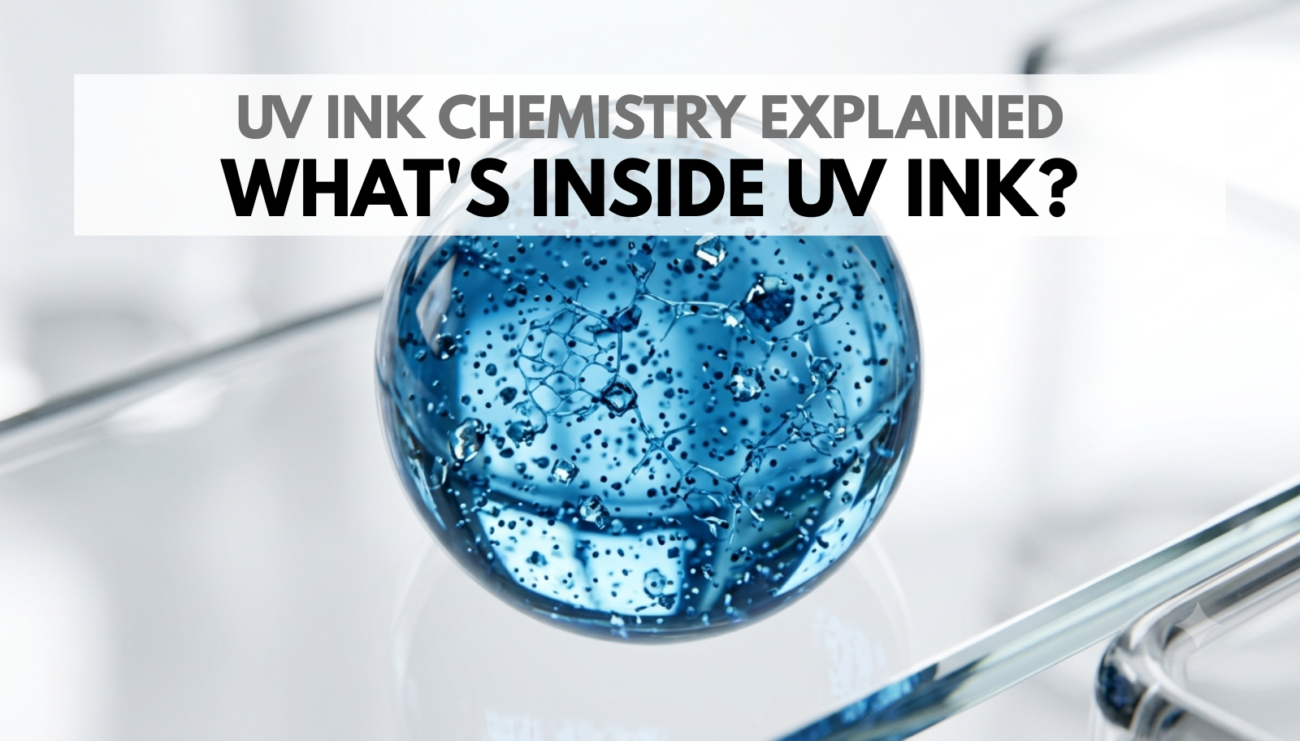
When people see UV ink for the first time, they often think of it as nothing more than colored liquid. In reality, every bottle or cartridge contains a highly engineered chemical system designed to produce durable, vibrant prints in just seconds.
Unlike water-based or solvent inks, UV ink contains ingredients that remain liquid until they are exposed to ultraviolet light. Once exposed, those ingredients react almost instantly, transforming into a durable solid film.
Each ingredient has a specific purpose. Remove or change one component and the entire performance of the ink can change.
UV Ink Is More Than Just Color
Think of UV ink like baking a cake.
The flour, eggs, sugar and baking powder each perform different jobs. If you leave one ingredient out or change the proportions, the finished cake will be completely different.
UV ink works much the same way.
Every ingredient has a carefully engineered role that contributes to:
- Color accuracy
- Print adhesion
- Scratch resistance
- Chemical resistance
- Flexibility
- Gloss level
- Curing speed
- Printhead reliability
The chemistry behind UV ink is all about balance.
The Five Primary Ingredients
Most UV inks contain five major categories of components:
- Pigments
- Oligomers
- Monomers
- Photoinitiators
- Additives
Each one contributes to the final performance of the printed image.
Pigments
Pigments are microscopic solid particles that create the visible color of the ink.
Unlike dyes, pigments do not dissolve into the liquid. Instead, they remain suspended throughout the ink formulation.
This suspension allows pigments to provide:
- Bright colors
- Excellent opacity
- High durability
- Better UV resistance
- Longer outdoor life
Pigments are manufactured with extremely consistent particle sizes to ensure smooth printing through today's high-performance printheads.
Why Particle Size Matters
Modern printheads contain microscopic nozzles.
If pigment particles are too large or begin to clump together, they can:
- Restrict ink flow
- Cause nozzle dropouts
- Reduce image quality
- Increase maintenance
This is why UV ink manufacturers carefully control pigment dispersion during production.
Every particle must remain evenly distributed throughout the ink.
Color Isn't the Only Job
Pigments also influence:
- Color saturation
- Opacity
- Lightfastness
- Weather resistance
- Print consistency
The quality of the pigment directly affects how vivid and durable the final print becomes.
Oligomers
The Backbone of UV Ink
If pigments provide the color, oligomers provide the structure.
Oligomers are larger molecules that become the backbone of the cured ink film.
After curing, they largely determine:
- Hardness
- Flexibility
- Chemical resistance
- Abrasion resistance
- Outdoor durability
Different applications require different oligomer combinations.
For example:
A rigid sign may require a harder cured surface.
A flexible label may require an ink that bends without cracking.
Manufacturers select oligomers based on the intended application.
Why Oligomers Matter
Imagine building a house.
The pigments are the paint.
The oligomers are the wooden frame.
Without a strong frame, the house cannot support itself.
Without oligomers, UV ink would have very little strength after curing.
Monomers
Monomers are smaller molecules that help adjust the viscosity of UV ink.
Viscosity refers to how thick or thin a liquid is.
The correct viscosity allows ink to:
- Flow smoothly through the printhead
- Form consistent droplets
- Produce sharp images
- Cure evenly
Monomers also become part of the cured ink film during the UV curing process.
Balancing Performance
Too many monomers may create an ink that cures with excessive shrinkage or reduced durability.
Too few may produce an ink that is too thick to jet consistently.
Finding the right balance is one of the biggest challenges in UV ink formulation.
Real-World Example
Imagine trying to spray honey through a fine mist sprayer.
It would clog almost immediately.
Now imagine spraying water.
It flows easily but provides almost no coating.
UV ink is carefully engineered to fall between these extremes, providing smooth jetting while still creating a durable printed image after curing.
Photoinitiators
The Ingredient That Starts Everything
Photoinitiators are unique chemicals that respond to ultraviolet light.
Before exposure, they remain inactive inside the liquid ink.
When exposed to UV energy, they absorb the light and create highly reactive molecules that initiate polymerization. This rapid chemical reaction links the oligomers and monomers together, transforming the liquid ink into a solid coating within seconds.
Without photoinitiators, UV ink would remain liquid no matter how much color or resin it contained.
The type and concentration of photoinitiators play a major role in curing speed, surface finish and overall print performance.
Additives
The Fine-Tuning Ingredients
Although they make up a relatively small portion of the formulation, additives have a significant impact on how UV ink performs.
Depending on the application, additives may improve:
- Surface wetting
- Adhesion
- Scratch resistance
- Gloss or matte appearance
- Flow characteristics
- Pigment stability
- Shelf life
- Foam control
These specialty ingredients help ensure that the ink performs consistently during manufacturing, printing and long-term use.
How All the Ingredients Work Together
No ingredient works alone.
A successful UV ink formulation depends on achieving the right balance between every component.
Think of it as an orchestra.
Pigments provide the visual performance.
Oligomers provide strength.
Monomers help the ink flow and participate in curing.
Photoinitiators trigger the curing reaction.
Additives fine-tune the overall performance.
If one section of the orchestra is out of tune, the final performance suffers. The same is true for UV ink chemistry.
Why Formulation Matters
Two UV inks may look nearly identical inside their bottles, yet produce very different results.
Small changes in formulation can affect:
- Adhesion to different materials
- Color consistency
- Flexibility
- Chemical resistance
- Outdoor durability
- Printhead reliability
- Cure speed
- Surface finish
This is why UV ink development requires extensive laboratory testing and quality control.
Common Misconceptions
"UV Ink Is Just Colored Plastic"
Not exactly.
Although the cured ink forms a durable polymer film, the liquid ink is a carefully engineered mixture of several specialized ingredients that must work together throughout the printing process.
"All UV Inks Are the Same"
Different formulations are designed for different printers, printheads, UV lamp technologies and application requirements.
Changing even one ingredient can significantly alter performance.
"More Pigment Means Better Color"
Adding more pigment does not automatically improve image quality.
Too much pigment can increase viscosity, reduce curing efficiency and negatively affect printhead performance.
Successful formulations balance pigment concentration with the rest of the chemistry.
Why This Matters to Print Shops
Understanding the basic chemistry of UV ink helps operators make better decisions about storage, maintenance and printer operation.
It also explains why:
- Different inks should not be mixed unless approved by the manufacturer.
- Proper curing is essential for long-term durability.
- Printer settings are often optimized for a specific ink formulation.
- Environmental conditions can influence print quality and consistency.
Even a small change in chemistry can affect the final printed result.
Conclusion
Every drop of UV ink is the result of careful chemical engineering.
Pigments create color. Oligomers build strength. Monomers control flow and become part of the cured structure. Photoinitiators activate the curing process. Additives refine performance and improve reliability.
Together, these ingredients allow UV printers to produce vibrant, durable prints on a wide variety of materials with remarkable speed and consistency.
Understanding what is inside UV ink provides the foundation for understanding how the curing process works, which is the focus of the next episode in this series.
Key Takeaways
- UV ink is a carefully engineered chemical formulation rather than simply colored liquid.
- Pigments provide color, opacity and long-term durability.
- Oligomers form the backbone of the cured ink film.
- Monomers control viscosity and become part of the cured structure.
- Photoinitiators absorb UV light and initiate the curing reaction.
- Additives improve adhesion, flow, stability and surface properties.
- Every ingredient must remain in balance for optimal print quality.
- Different UV ink formulations are designed for different printers and applications.
FAQ
What are the main ingredients in UV ink?
UV ink typically contains pigments, oligomers, monomers, photoinitiators and performance additives.
Why doesn't UV ink dry like regular ink?
UV ink remains liquid until exposed to ultraviolet light, which triggers a chemical reaction that cures the ink almost instantly.
What do photoinitiators do?
Photoinitiators absorb UV energy and initiate the polymerization process that converts liquid ink into a durable solid film.
Are pigments the same as dyes?
No. Pigments are solid particles suspended in the ink, while dyes dissolve into the liquid. Pigments generally provide better durability and light resistance.
Why is viscosity important in UV ink?
Proper viscosity allows ink to jet consistently through microscopic printhead nozzles while producing accurate droplet formation.
Can different UV inks be mixed together?
Mixing different formulations is generally not recommended because differences in chemistry can affect curing, color, adhesion and printhead performance.
Why are additives necessary if they make up only a small percentage of the ink?
Additives fine-tune critical characteristics such as adhesion, gloss, flow, pigment stability and scratch resistance, making them essential for consistent performance.
Does every UV printer use the same type of UV ink?
No. Ink formulations are often optimized for specific printheads, curing systems and application requirements.
Next Episode Preview
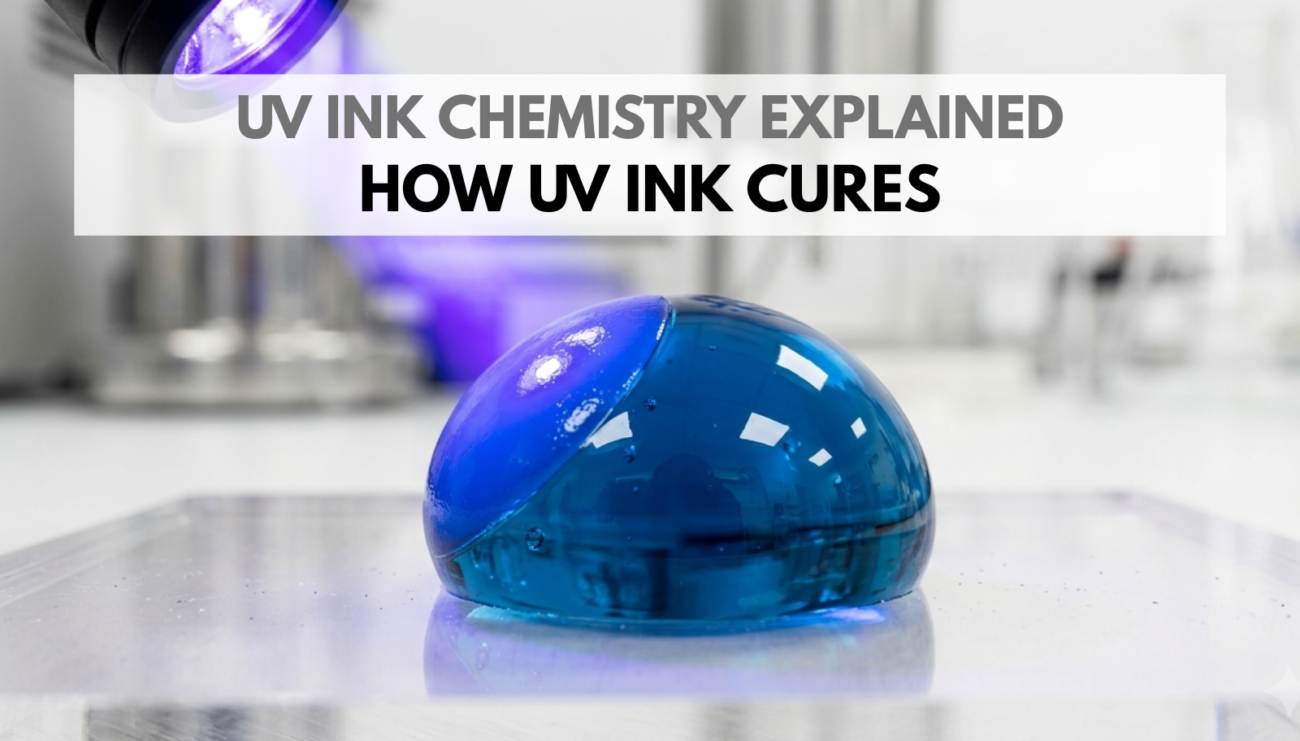
In Episode 3, How UV Ink Cures, we'll follow a single drop of UV ink from the moment it lands on the substrate to the instant it transforms into a durable solid. You'll learn how UV LEDs, photoinitiators and polymerization work together to create a fully cured print in just seconds.