 MADE IN USA



How UV Ink Cures: The Science Behind Instant Printing
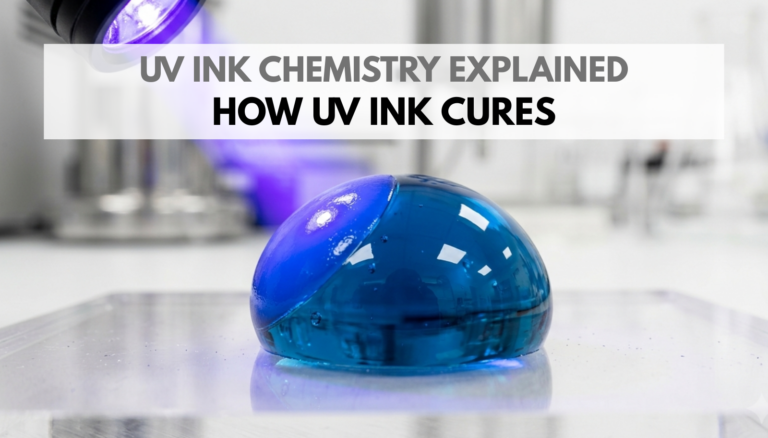
How UV ink cures is one of the most important processes in UV printing. Freshly printed liquid ink passes under UV light and transforms into a durable solid almost instantly.
Unlike solvent, latex or water-based inks that rely on evaporation or heat, UV ink undergoes an entirely different process. It doesn't dry. It cures.
That distinction is one of the reasons UV printing has become so popular across industries ranging from signage and packaging to promotional products and industrial manufacturing.
In this article, we'll explore exactly how UV ink cures, what happens during the chemical reaction and why proper curing makes such a significant difference in print quality and durability.
Drying vs. Curing
To better understand how UV ink cures, it's important to first understand the difference between drying and curing.
Many people use the words "dry" and "cure" interchangeably, but in printing they describe two completely different processes.
Traditional inks become dry because something leaves the ink.
For example:
- Water-based inks lose water.
- Solvent inks release solvents into the air.
- Latex inks require heat to evaporate water before the resin forms a film.
However, UV ink behaves differently.
Almost nothing evaporates from the printed ink. Instead, the liquid ingredients react with one another when exposed to ultraviolet light, forming an entirely new solid material.
For example, think of it like mixing concrete.
Before it hardens, concrete is a liquid mixture. Once the chemical reaction occurs, it becomes a strong, durable solid.
UV ink follows a similar concept, although the chemistry happens much faster.
What Happens When UV Light Hits the Ink?
The process of how UV ink cures begins the moment ultraviolet light reaches the freshly printed ink.
The curing process begins the moment ultraviolet light reaches freshly printed ink.
Inside every UV ink are special molecules called photoinitiators.
These molecules remain inactive while the ink sits inside the cartridge or ink delivery system. They only become active when exposed to the correct wavelength of ultraviolet light.
Once activated, photoinitiators begin a rapid chemical reaction known as polymerization.
During polymerization:
- Photo initiators absorb UV energy.
- Reactive molecules are created.
- Oligomers and monomers begin linking together.
- Millions of molecular bonds form almost instantly.
- The liquid ink transforms into a solid polymer network.
As a result, this entire process often takes less than one second.
How UV Ink Cures Through Polymerization
Understanding how UV ink cures through polymerization helps explain why UV prints become durable almost instantly after exposure to ultraviolet light.
Imagine dumping thousands of loose Lego bricks onto a table.
At first, none of the bricks are connected.
As you begin snapping them together, a strong structure starts to form.
Eventually, the entire collection becomes one interconnected object.
That is very similar to what happens inside UV ink.
Before curing:
- Molecules move freely.
- The ink remains liquid.
- The print can easily smear.
After curing:
- Molecules connect together.
- The surface hardens.
- The print becomes durable and resistant to damage.
The stronger this polymer network becomes, the better the finished print generally performs.
Why Photoinitiators Are So Important
Photoinitiators are often described as the "spark" that starts the curing reaction.
Without them, UV light would shine directly onto the ink with little effect.
Photoinitiators absorb the UV energy and convert that light into chemical activity.
Different photoinitiators respond to different UV wavelengths.
This is one reason ink manufacturers carefully formulate inks for specific printer technologies.
An ink designed for one curing system may not cure properly in another system if the wavelengths do not match.
Modern UV LED Technology
Early UV printers relied on mercury vapor lamps.
These lamps generated broad-spectrum ultraviolet light along with significant amounts of heat.
Today, printers increasingly use UV LED curing systems.
UV LED lamps provide several advantages:
- Lower operating temperatures
- Lower power consumption
- Longer lamp life
- More consistent output
- Reduced maintenance
- Better compatibility with heat-sensitive materials
As a result, because LEDs produce much less heat, they allow printers to decorate materials that might otherwise warp or deform under traditional UV lamps.
This has greatly expanded the range of printable substrates.
Why Curing Happens So Quickly
One of the biggest advantages of UV technology is speed.
Unlike traditional inks that may require minutes or even hours before reaching full strength, UV ink reaches functional hardness almost immediately after exposure to sufficient UV energy.
Several factors contribute to this rapid curing:
- Highly reactive chemistry
- Efficient photoinitiators
- Powerful UV LED lamps
- Optimized ink formulations
- Precise control of lamp intensity and exposure time
The result is a production workflow that minimizes waiting between printing, finishing and shipping.
The Importance of Proper UV Exposure
Although curing happens quickly, it still depends on receiving the correct amount of ultraviolet energy.
Too little energy may leave portions of the ink only partially cured.
Too much energy can also create problems depending on the application.
Printer manufacturers carefully balance:
- Lamp intensity
- Exposure time
- Print speed
- Ink thickness
- Distance between lamp and substrate
Together, these variables work to achieve consistent curing.
What Happens If UV Ink Is Under-Cured?
Under-curing occurs when the ink does not receive enough UV energy to complete polymerization.
Symptoms may include:
- Sticky or tacky surfaces
- Smearing
- Reduced scratch resistance
- Poor chemical resistance
- Weak adhesion
- Premature fading
- Surface marking during handling
Consequently, in severe cases, the printed image may fail entirely during normal use.
Can UV Ink Be Over-Cured?
While less common, excessive UV exposure can also affect print performance.
Depending on the ink formulation and substrate, over-curing may contribute to:
- Increased brittleness
- Reduced flexibility
- Higher likelihood of cracking on flexible materials
- Changes in surface appearance
Fortunately, modern UV printers help minimize this risk by controlling curing conditions automatically.
Why Ink Thickness Matters
Not every printed layer cures at exactly the same rate.
For example, a thin layer allows UV light to penetrate easily.
A thick layer, such as textured or raised printing, may require additional curing energy because light must penetrate deeper into the ink.
Manufacturers account for this when designing specialty UV printing applications.
The Role of Oxygen
Interestingly, oxygen can interfere with certain UV curing reactions.
At the very surface of the print, oxygen may slow polymerization slightly, a phenomenon known as oxygen inhibition.
Modern UV ink formulations are designed to minimize this effect, allowing the surface to cure efficiently while maintaining excellent print quality.
Factors That Influence UV Curing
Several variables affect curing performance every day in production environments.
These include:
Lamp Output
Over time, as UV lamps age, their output gradually decreases. Regular maintenance helps maintain consistent curing performance.
Print Speed
Faster printing reduces the amount of UV exposure unless lamp power is adjusted accordingly.
Ink Formulation
Each manufacturer develops ink chemistry specifically for compatible printers and curing systems.
Substrate Properties
Glass, acrylic, aluminum, PVC, wood and other materials reflect and absorb UV light differently, influencing overall curing performance.
Environmental Conditions
In addition, temperature and humidity can affect ink flow and substrate characteristics, although UV curing itself is generally less sensitive to environmental changes than solvent drying.
Why Proper Curing Matters
Proper curing influences far more than whether the print feels dry.
It directly affects:
- Adhesion
- Scratch resistance
- Chemical resistance
- Outdoor durability
- Color stability
- Gloss consistency
- Flexibility
- Long-term performance
When curing is optimized, the printed image becomes a durable part of the substrate rather than simply sitting on the surface.
Common Misconceptions About UV Curing
"The ink simply dries."
False.
UV ink cures through polymerization rather than evaporation.
"More UV power is always better."
Not necessarily.
Proper curing requires balanced exposure, not simply maximum lamp intensity.
"All UV inks cure the same way."
Different ink formulations are engineered for specific printers, lamp technologies and applications.
"If it feels dry, it must be fully cured."
Not always.
An under-cured print may feel dry initially but still lack optimal durability and chemical resistance.
The Bottom Line
The ability of UV ink to cure almost instantly is one of the technologies that transformed modern digital printing.
Instead of waiting for liquids to evaporate, UV inks use carefully engineered chemistry that reacts to ultraviolet light in fractions of a second. This rapid polymerization creates durable, vibrant prints on an impressive variety of materials while enabling faster production and improved efficiency.
Ultimately, understanding how UV curing works also helps explain why printer settings, lamp maintenance and ink compatibility are so important. Every component of the system contributes to achieving a properly cured print that looks great and performs reliably over time.
As UV printing technology continues to evolve, advances in photoinitiators, LED curing systems and polymer chemistry will continue expanding the possibilities for digital printing across countless industries.
Key Takeaways
- UV ink cures through a chemical reaction rather than evaporation.
- Photoinitiators absorb UV light and begin polymerization.
- Polymerization links molecules together into a durable solid network.
- UV LED lamps provide efficient curing with less heat.
- Proper curing improves adhesion, durability and chemical resistance.
- Under-curing can reduce print performance and longevity.
- Excessive curing may reduce flexibility in some applications.
- Ink formulation and curing technology are designed to work together.
- Proper UV curing enables immediate handling and faster production.
- Understanding curing helps operators achieve more consistent print quality.
FAQ
What does it mean for UV ink to cure?
UV curing is the chemical process in which ultraviolet light activates photoinitiators inside the ink. As a result, these photoinitiators trigger polymerization, transforming the liquid ink into a durable solid coating almost instantly.
How is curing different from drying?
Drying removes water or solvents from an ink. In contrast, curing changes the chemistry of the ink itself by creating new molecular bonds that form a solid polymer network.
What are photoinitiators?
Photoinitiators are specialized chemicals that absorb ultraviolet light and then generate the reactive molecules needed to start the polymerization process.
Why do UV printers use LED lamps?
UV LED lamps consume less power, produce less heat and last longer than traditional mercury lamps. Additionally, they provide consistent curing performance for a wide variety of materials.
Can UV ink cure without UV light?
No. Instead, UV ink is specifically formulated to remain liquid until exposed to the correct wavelength of ultraviolet light.
What happens if UV ink is not fully cured?
Under-cured ink may feel tacky, scratch easily, exhibit poor adhesion or fail prematurely during normal use.
Does thicker ink require more curing energy?
Yes. Thick or textured ink layers can require additional UV exposure because the light must penetrate deeper into the material.
Why is proper curing important for durability?
A fully cured polymer network provides better scratch resistance, chemical resistance, adhesion and long-term performance than partially cured ink.
Next Episode Preview
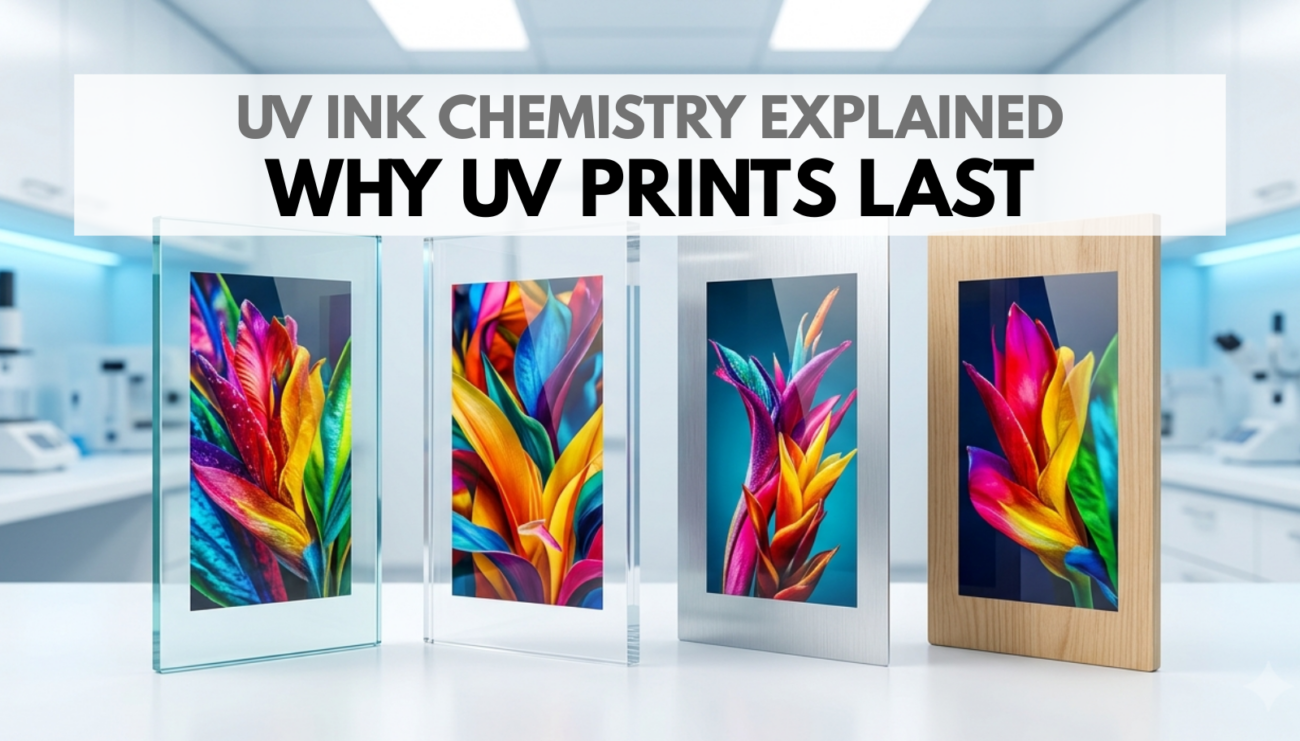
Now that you've learned how UV ink transforms from a liquid into a durable solid, the next question is: why do UV prints last so long? In Episode 4, we'll explore the science behind UV print durability, including scratch resistance, weatherability, chemical resistance and the factors that help UV graphics maintain their appearance over time.