 MADE IN USA



What Is UV Ink? Understanding the Technology Behind Modern Digital Printing
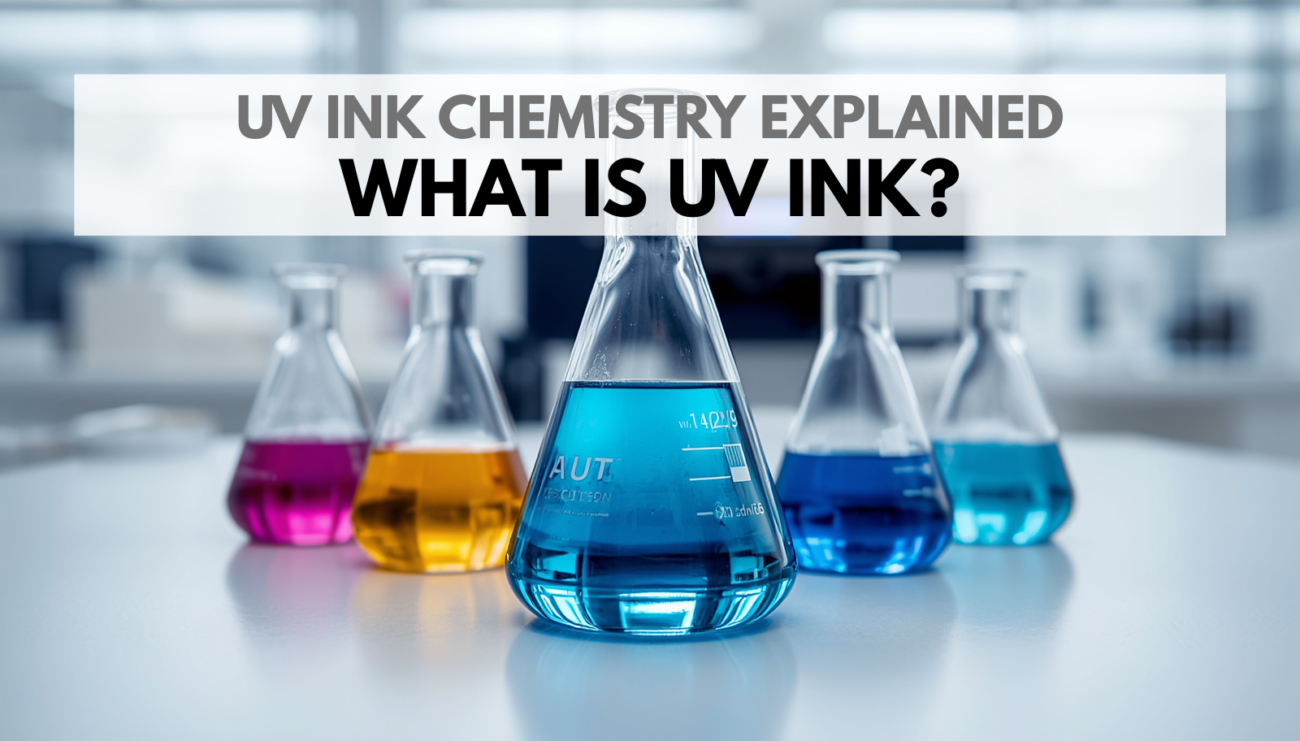
From promotional products to industrial manufacturing, UV ink has transformed digital printing by curing almost instantly and adhering to an incredible variety of materials. In this first episode of our UV Ink Chemistry Explained series, discover what UV ink is, how it works and why it has become one of the industry's most versatile printing technologies.
What Is UV Ink?
First, If you've worked around digital printing, you've probably heard the term UV ink. It appears everywhere from flatbed printers and label presses to industrial manufacturing and promotional product decoration. But what exactly makes UV ink different from traditional printing inks?
The answer lies in chemistry.
Unlike conventional inks that dry by evaporation or absorption, UV ink changes from a liquid into a solid almost instantly when exposed to ultraviolet light. This unique curing process allows printers to produce vibrant graphics on materials that many other ink technologies simply cannot handle.
Understanding how UV ink works is the foundation for understanding every other topic in this series.
What Makes UV Ink Different?
What Makes UV Ink Different?
Most traditional inks rely on one of two methods to become dry.
The first is evaporation. Solvents or water leave the ink, allowing pigments and resins to remain on the surface.
The second is absorption. The liquid portion of the ink penetrates into porous materials such as paper while the remaining solids stay behind.
In contrast, UV ink works differently.
Instead of losing liquid through evaporation, UV ink undergoes a chemical reaction. Ultraviolet energy activates special ingredients inside the ink, causing millions of molecules to rapidly bond together into a durable solid film.
As a result, this transformation takes place in seconds.
Think of it like pouring liquid concrete into a mold. Once it hardens, it becomes a completely different material. UV ink behaves similarly, except the process happens almost instantly using light instead of time.
Why Is It Called UV Ink?
Why Is It Called UV Ink?
The letters "UV" stand for ultraviolet.
In fact, ultraviolet light exists just beyond the visible spectrum that humans can see.
While sunlight naturally contains UV energy, UV printers use carefully controlled UV LED lamps or mercury lamps that produce very specific wavelengths designed to cure the ink efficiently and consistently.
Without the proper UV light source, the ink remains liquid.
A Different Way of Thinking About Drying
One of the biggest misconceptions is that UV ink dries.
Technically, it doesn't.
Instead, it cures.
Drying removes liquid.
Curing creates an entirely new molecular structure.
That distinction is important because curing gives UV prints many of their unique performance characteristics including:
- Excellent scratch resistance
- Strong chemical resistance
- High durability
- Excellent color density
- Ability to print on non-porous materials
Where Is UV Ink Used?
One reason UV printing has become so popular is its versatility.
Today, UV printers can decorate a wide range of products including:
- Acrylic signs
- Glass
- Aluminum
- Stainless steel
- Wood
- PVC
- Foam board
- Leather
- Plastic
- Phone cases
- Promotional products
- Packaging
- Labels
- Industrial components
- Customized gifts
Since the ink cures on the surface rather than soaking into the material, UV printing can produce vibrant images on substrates that traditional inks often struggle to print.
UV Ink vs Other Printing Technologies
Understanding how UV ink compares with other common ink technologies helps explain why each has its own place in the printing industry.
Water-Based Ink
Water-based inks primarily rely on water evaporation and absorption into porous materials.
Best for:
- Paper
- Cardboard
- Packaging
- Some textiles
Eco-Solvent Ink
Eco-solvent inks use mild solvents that soften coated vinyl surfaces, allowing pigments to anchor into the material.
Common applications include:
- Vehicle wraps
- Outdoor graphics
- Banners
- Window graphics
Solvent Ink
Traditional solvent inks penetrate aggressively into compatible media and are known for excellent outdoor durability.
Typical uses include:
- Billboards
- Fleet graphics
- Large signage
Latex Ink
Latex inks use heat to evaporate water while latex polymers fuse together.
Popular for:
- Wall graphics
- Indoor signage
- Retail displays
UV Ink
UV ink cures almost instantly using ultraviolet light and adheres to many rigid and flexible materials.
Typical applications include:
- Flatbed printing
- Industrial manufacturing
- Promotional products
- Packaging
- Decorative printing
- Specialty applications
No single technology is universally better than another. Each was developed to solve different printing challenges.
Why Instant Curing Matters
Because UV ink cures almost immediately, production can move much faster.
Printed parts often require little or no waiting time before:
- Cutting
- Packaging
- Shipping
- Laminating
- Assembly
This can improve workflow efficiency in many production environments.
Common Misconceptions About UV Ink
"UV ink dries."
Not exactly.
UV ink cures through polymerization rather than drying through evaporation.
"UV printing only works on rigid materials."
Many UV printers can also print on flexible materials depending on the ink formulation and printer design.
"All UV inks are the same."
Different UV ink formulations are engineered for different printheads, curing systems, substrates and performance requirements.
Why Understanding UV Ink Chemistry Matters
Many print quality issues can be traced back to the chemistry of the ink itself.
Understanding the basics helps operators better recognize:
- Adhesion problems
- Under-curing
- Over-curing
- Surface compatibility
- Environmental influences
- Print durability
Learning the science behind the ink makes troubleshooting much easier.
Key Takeaways
- UV ink cures using ultraviolet light rather than drying through evaporation.
- The curing process forms a durable polymer network in seconds.
- UV printing can decorate many rigid and flexible materials.
- Instant curing helps increase production efficiency.
- UV ink differs significantly from solvent, eco-solvent, latex and water-based inks.
- Understanding UV chemistry provides the foundation for troubleshooting and print optimization.
FAQ
What is UV ink?
UV ink is a liquid printing ink that cures into a solid when exposed to ultraviolet light, creating a durable printed image.
Does UV ink dry?
No. UV ink cures through a chemical reaction instead of drying through evaporation.
What materials can UV ink print on?
Depending on the formulation and printer, UV ink can print on glass, acrylic, wood, plastic, metal, PVC, leather, foam board and many other materials.
Why is UV printing so fast?
Because the ink cures almost instantly under UV light, printed products are often ready for handling immediately after printing.
Is UV ink waterproof?
Properly cured UV prints generally offer excellent resistance to water, chemicals and abrasion, although performance depends on the ink formulation and substrate.
Is UV ink environmentally friendly?
Since UV inks contain little or no volatile solvents compared with many traditional solvent inks, they can reduce VOC emissions. Environmental impact still depends on the specific formulation, manufacturing and disposal practices.
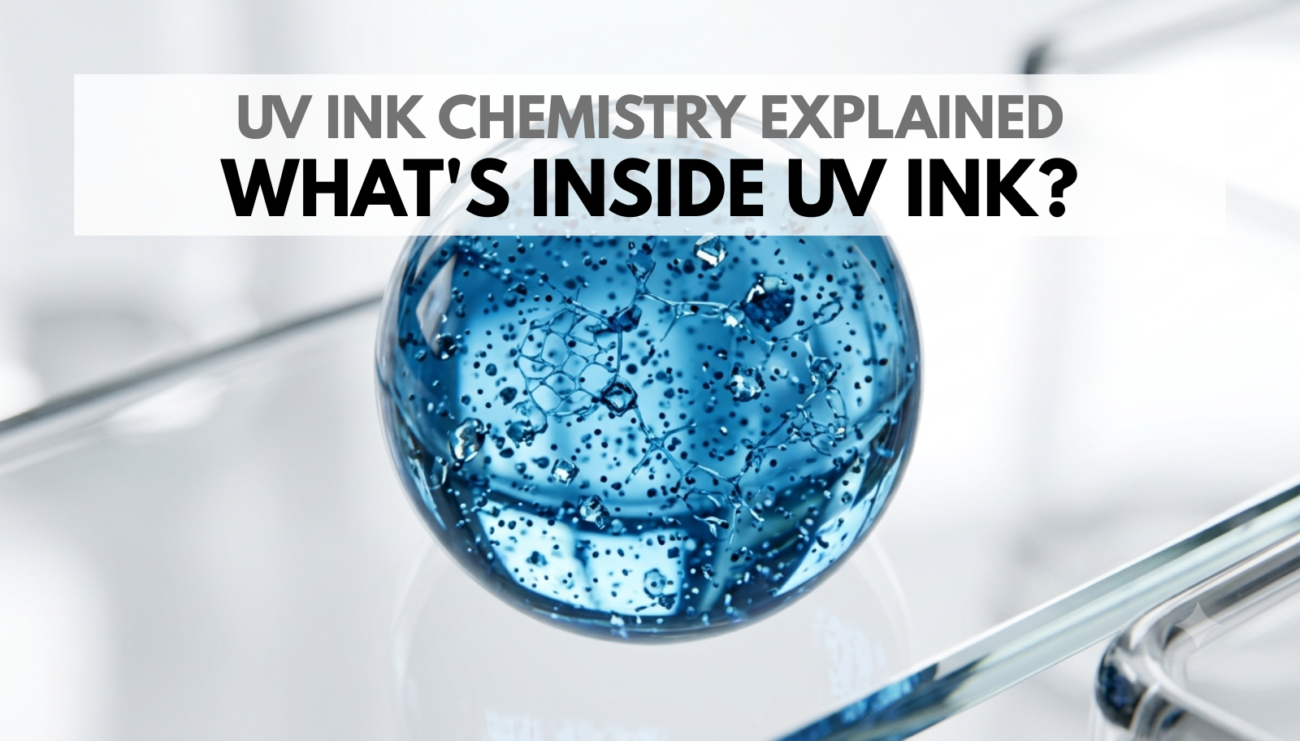
Ready to go deeper? Continue to Episode 2: What's Inside UV Ink? to learn about the five key ingredients that make UV ink work.
Next Episode Preview
Now that you understand what UV ink is, it's time to look inside the chemistry itself. In Episode 2, we'll explore the five primary ingredients that make UV ink work: pigments, oligomers, monomers, photoinitiators and additives. You'll learn what each component does and why every drop of UV ink is the result of carefully balanced chemistry.