 MADE IN USA



Why White Ink Stability Matters
The Most Important Ink in Your Printer Is Often the Most Challenging to Manage
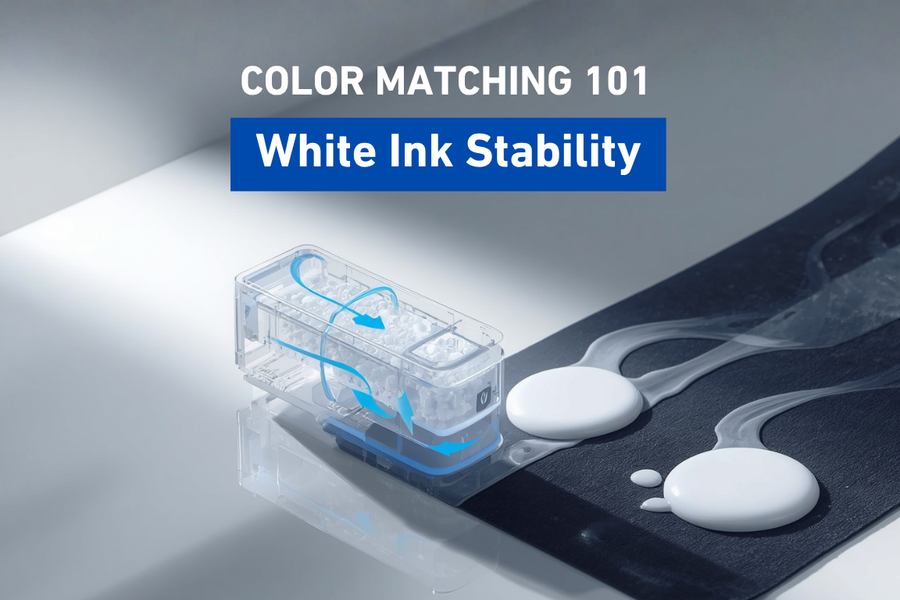
White ink makes many of today's most popular printing applications possible, from vibrant DTF transfers to UV graphics on clear and dark materials. But unlike other ink colors, maintaining white ink stability requires ongoing attention. Understanding why it behaves differently is one of the keys to maintaining consistent print quality and keeping your printer performing at its best.
The Ink That Works Hardest
If you've spent any time around a DTF, UV, or UV DTF printer, you've probably heard someone say, "Make sure you shake the white ink," or "Don't let the white channels sit too long."
If you're new to digital printing, that advice may seem strange.
After all, why would one ink require special treatment while cyan, magenta, yellow, and black seem to work without much attention?
The answer lies in what makes white ink different.
Unlike other process colors, white ink contains a much heavier concentration of pigment. Those pigments allow it to create an opaque white layer that serves as the foundation for vibrant colors on dark, transparent, or colored materials.
As a result, without white ink, many of the applications we see every day simply wouldn't be possible.
Why White Ink Is Different
Most colored inks are designed to be relatively transparent.
White ink is different because its job is to block light rather than allow light to pass through.
To accomplish this, manufacturers use white pigments that are significantly denser than the pigments found in most other inks.
These heavier particles naturally want to settle over time.
Imagine filling a glass with water and adding fine sand.
At first, the mixture looks uniform.
Leave it alone for a while, and the sand begins settling to the bottom.
White ink behaves in a similar way.
While the particles are much smaller and specially formulated for printing, gravity is always working against them.
That's why proper ink circulation is so important.
What Happens When White Ink Settles?
When white pigment settles inside a cartridge, ink tank, or supply system, the concentration of pigment becomes uneven.
This can lead to several issues:
- Inconsistent opacity
- Uneven white coverage
- Color shifts
- Banding
- Nozzle clogging
- Increased maintenance
- Reduced print quality
In severe cases, excessive settling can restrict ink flow and contribute to unnecessary downtime.
The good news is that these issues are often preventable through proper maintenance and routine operation.
Why White Ink Affects Color
At first glance, white ink may seem unrelated to color matching.
In reality, it plays a significant role.
DTF printing relies on white ink to form the foundation beneath the colored image, while UV printing uses it to help vibrant colors stand out on dark or transparent materials.
If the white layer changes from one print to another, the colors printed on top may also appear different.
A weak white underbase can make colors appear dull.
An inconsistent white layer can make graphics look uneven.
A stable white layer helps produce predictable color from one job to the next.
That's why managing white ink stability is an important part of color management.
Modern Printers Help Manage White Ink
Fortunately, today's digital printers include features designed to keep white ink moving.
Depending on the printer, these systems may include:
- Automatic ink circulation
- Ink agitation
- Scheduled maintenance cycles
- White ink recirculation systems
- Continuous mixing
- Automatic cleaning routines
These technologies help reduce settling and improve consistency, but they don't eliminate the need for regular operator attention.
Routine maintenance remains an essential part of reliable production.
The Role of Daily Maintenance
Every printer manufacturer provides recommended maintenance procedures.
Although the exact routine varies by model, many include tasks such as:
- Verifying ink levels
- Inspecting white ink circulation
- Performing nozzle checks
- Cleaning around the printhead
- Confirming proper ink flow
- Running scheduled maintenance cycles
These routines often require only a few minutes each day but can significantly reduce the likelihood of larger problems later.
Think of it like maintaining a vehicle.
Regular oil changes and inspections take far less time than replacing an engine.
The same principle applies to digital printers.
Does White Ink Expire?
Like many printing consumables, white ink has a recommended shelf life.
Over time, the chemical properties of any ink can change, especially if it is stored improperly.
Temperature extremes, prolonged storage, or repeated contamination can affect performance.
Following the manufacturer's recommendations for storage, handling, and inventory rotation helps maintain consistent results.
Using older ink isn't always a problem, but understanding recommended storage practices can reduce unnecessary risk.
White Ink and Production Confidence
Imagine printing a customer's order that includes hundreds of dark garments.
Everything looks perfect on the first few prints.
Then the white underbase gradually becomes weaker as production continues.
Now every print requires closer inspection.
Production slows.
Confidence decreases.
This is why experienced operators place so much emphasis on white ink stability.
Consistent white ink contributes to consistent production.
And consistent production builds customer confidence.
White Ink Is Part of a Complete Workflow
It's tempting to think of white ink as just another consumable.
In reality, it's an important part of the overall printing system.
Reliable white ink performance depends on several factors working together:
- Proper storage
- Routine maintenance
- Stable environmental conditions
- Well-maintained equipment
- Quality ink
- Appropriate printer settings
- Consistent operating procedures
Each contributes to dependable print quality.
Good Habits Make a Big Difference
One of the biggest lessons experienced print operators learn is that consistency comes from routine.
Simple habits performed every day often prevent larger issues from developing.
Those habits include:
- Following the manufacturer's maintenance schedule
- Monitoring printer performance
- Using recommended consumables
- Keeping the work environment clean
- Addressing small issues before they become larger ones
These practices not only support white ink stability but also improve the overall reliability of the printing workflow.
Why Understanding White Ink Matters
Whether you're printing custom apparel, promotional products, decals, signage, or specialty graphics, white ink often serves as the foundation for the finished image.
Understanding why it behaves differently helps operators make better decisions, maintain equipment more effectively, and produce more consistent results.
At STS Inks, we recognize that successful digital printing depends on more than high-quality chemistry. Reliable production comes from combining advanced ink formulations with proper maintenance, disciplined workflows, and operator education. That's why we believe Color is in Our DNA.
Conclusion
White ink is one of the most important components in many modern printing applications, but it also requires more attention than most other colors.
Its unique formulation makes regular circulation, proper maintenance, and good operating habits essential for reliable performance.
By understanding why white ink behaves differently and following recommended maintenance practices, print providers can reduce downtime, improve color consistency, and produce more dependable results for their customers.
Key Takeaways
- White ink contains heavier pigments that naturally settle over time.
- Proper circulation and maintenance help maintain consistent white ink performance.
- White ink quality directly affects color consistency in many printing applications.
- Routine maintenance helps prevent downtime and unnecessary print quality issues.
- Stable workflows produce more reliable and repeatable results.
Frequently Asked Questions
Why does settling occur over time?
White ink contains dense pigments that naturally settle due to gravity. Modern printers use circulation and agitation systems to help keep those pigments evenly suspended.
Why is white ink so important?
White ink creates an opaque foundation for printing on dark, transparent, or colored materials, allowing other colors to appear vibrant and accurate.
What happens without proper maintenance?
Settling can lead to inconsistent opacity, nozzle clogging, uneven coverage, color shifts, and increased maintenance requirements.
Do all printers have white ink circulation systems?
Many modern DTF and UV printers include automatic circulation or agitation systems, but features vary by manufacturer and model.
Does white ink affect color matching?
Yes. Because white ink often serves as the base layer, changes in its consistency can influence how colors appear in the finished print.
How often should maintenance be performed?
Always follow the manufacturer's recommendations. Many printers include daily maintenance routines that help maintain consistent performance.
Can white ink go bad?
Like other inks, white ink has a recommended shelf life and should be stored according to the manufacturer's guidelines to help maintain optimal performance.
Quick Definitions
White Ink Stability: The ability of white ink to remain properly mixed and perform consistently throughout the printing process.
Pigment Settling: The natural tendency of heavier pigment particles to move toward the bottom of an ink supply over time.
Ink Circulation: A system that continuously moves ink to help maintain an even pigment distribution.
Nozzle Check: A maintenance test used to verify that all printhead nozzles are firing correctly.
Underbase: A layer of white ink printed beneath colored inks to improve brightness and opacity on dark or transparent materials.

Next Episode
Episode 7: How Media Affects Color
You can use the same printer, the same ink, the same artwork, and the same settings, yet still end up with different colors. In the next episode, we'll explore one of the biggest reasons why: the media you're printing on. You'll learn how different materials influence color, why profiles matter, and how choosing the right media helps achieve consistent, predictable results.