 MADE IN USA




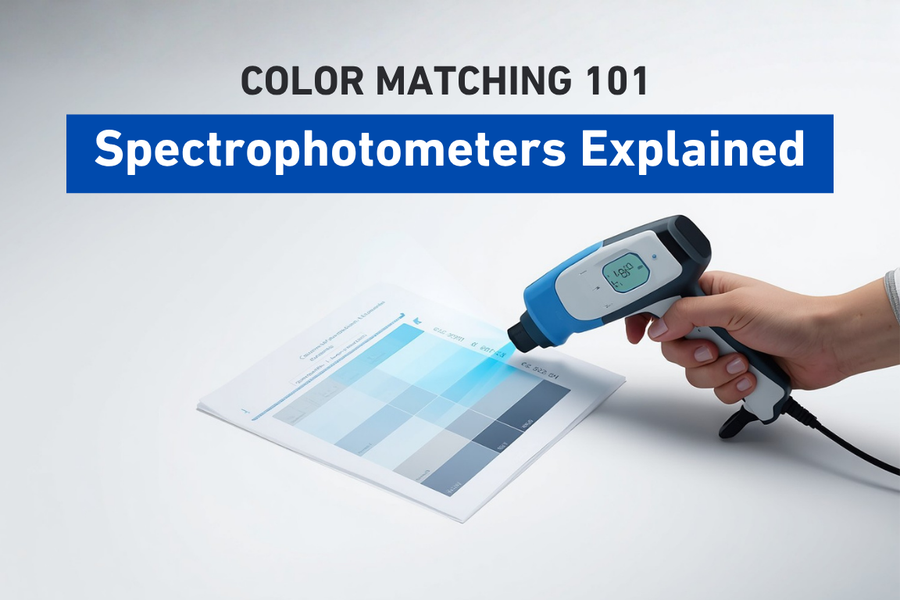
What is a Spectrophotometer
The Tool That Takes the Guesswork Out of Color Matching
Have you ever wondered how professional print shops know whether a color is actually correct? They don't rely on opinion or eyesight alone. Instead, they use a precision instrument called a spectrophotometer to measure color scientifically, helping ensure consistent, repeatable results from one print job to the next.
Seeing Color Isn't the Same as Measuring It
For example, imagine two people standing next to the same print.
One says the blue looks perfect.
The other insists it's slightly purple.
Who's right?
The answer might surprise you.
They both could be.
Human vision is remarkable, but it isn't perfect. The way we perceive color changes depending on lighting, surrounding colors, fatigue, age, and even the time of day. What looks correct to one person may appear slightly different to someone else.
In Episode 4, we introduced Delta E, the industry standard for measuring color differences. But that raises another question: if our eyes aren't reliable measuring tools, what is?
The answer is a spectrophotometer.
What Is a Spectrophotometer?
A spectrophotometer is a precision instrument that measures color by analyzing how light is reflected from a surface.
Rather than looking at a printed sample and making a judgment based on appearance, the instrument shines a controlled light onto the material and measures the reflected wavelengths.
From that information, software calculates the exact color values.
Think of it as the difference between estimating someone's height by looking at them and measuring it with a tape measure.
Both methods provide information, but one is objective and repeatable.
That's exactly what a spectrophotometer brings to color management.
Why Isn't Our Eyesight Enough?
Most people trust their eyes.
After all, we've been using them our entire lives.
But our vision constantly adapts to our surroundings.
For example:
- A white shirt looks different under warm indoor lighting than it does outside on a sunny day.
- A gray wall may appear blue when surrounded by orange colors.
- A print viewed under fluorescent lights may look slightly different under LED lighting.
Our brains automatically compensate for these changes without us even realizing it.
While that's helpful in everyday life, it creates challenges when color accuracy matters.
A spectrophotometer doesn't experience fatigue, bias, or changing perception. It measures color the same way every time.
How Does a Spectrophotometer Work?
Although the technology inside is sophisticated, the basic process is surprisingly straightforward.
The instrument:
- Shines a controlled light source onto the printed sample.
- Measures the wavelengths of light reflected back.
- Converts those measurements into standardized color values.
- Compares the measured color to a target or reference.
- Reports the difference using values such as Delta E.
Instead of asking, "Does this look close?" you can ask, "How close is it?"
That simple change transforms color evaluation from opinion into measurement.
What Can a Spectrophotometer Measure?
A spectrophotometer provides much more information than whether two colors look similar.
In addition, it can measure:
- Color values
- Delta E
- Density
- White point
- Color consistency
- Ink performance
- Media performance
Many professional workflows also use these measurements to create ICC profiles, calibrate printers, and verify production quality.
Where Are Spectrophotometers Used?
Although they're common in digital printing, spectrophotometers are used in many industries where color matters.
These include:
- Commercial printing
- Textile manufacturing
- Packaging
- Automotive finishes
- Paint manufacturing
- Plastics
- Consumer products
- Photography
- Medical devices
Any industry that requires accurate, repeatable color can benefit from objective color measurement.
Do Small Print Shops Need One?
Not every print shop owns a spectrophotometer.
Many smaller businesses rely on manufacturer-provided ICC profiles and visual evaluation.
That approach can produce excellent results for many applications.
However, as production volumes increase and customers demand tighter color consistency, measurement becomes increasingly valuable.
For shops producing brand-critical graphics, packaging, retail displays, or corporate identity materials, a spectrophotometer can help reduce reprints, improve repeatability, and build customer confidence.
Spectrophotometers Help Build ICC Profiles
Back in Episode 3, we discussed ICC profiles and how they help devices communicate color.
But where do those profiles come from?
One common method involves measuring hundreds or even thousands of printed color patches with a spectrophotometer.
The collected measurements describe exactly how a printer, ink set, and media combination reproduces color.
Specialized software then uses that information to build a custom ICC profile.
Without accurate measurements, creating reliable profiles would be nearly impossible.
Why Consistency Matters More Than Perfection
It's easy to think the goal of a spectrophotometer is finding "perfect" color.
In reality, its greatest strength is consistency.
Imagine a customer reorders a banner six months after the original project.
Even if the first print wasn't mathematically perfect, producing the second banner so it closely matches the first is often far more important.
Customers remember consistency.
A spectrophotometer helps print providers deliver that consistency with confidence.
A Tool That Supports Better Decisions
A spectrophotometer doesn't replace experience.
It enhances it.
Experienced operators still evaluate print quality, inspect details, and understand production variables.
The instrument simply provides reliable data that supports those decisions.
Instead of making repeated adjustments based on visual estimates, operators can verify whether changes are actually improving color accuracy.
This leads to more efficient workflows and greater confidence throughout production.
Spectrophotometers Are Part of a Complete Workflow
Owning a spectrophotometer alone won't guarantee accurate color.
In fact, it works best as part of a complete color management system that includes:
- Proper monitor calibration
- Accurate ICC profiles
- Consistent media
- Reliable RIP settings
- Stable environmental conditions
- Regular printer maintenance
- High-quality inks
When these elements work together, color becomes significantly more predictable and repeatable.
Why Understanding Spectrophotometers Matters
You don't need to own a spectrophotometer to appreciate its value.
In addition, understanding how color is measured helps explain why professional print shops are able to maintain consistent results across different jobs, operators, and production runs.
It also helps you understand why objective measurement has become such an important part of modern color management.
At STS Inks, we know that successful color management is built on more than quality products alone. It requires reliable workflows, consistent testing, and a commitment to continuous improvement. Precision tools such as spectrophotometers help printers validate their results and maintain confidence in every print. That's one of the reasons we believe Color is in Our DNA.
Conclusion
Color is one of the most important aspects of any printed product, but judging it by eye alone has its limits.
A spectrophotometer provides an objective, repeatable way to measure color, helping printers move beyond guesswork and toward measurable consistency.
Whether it's creating ICC profiles, verifying production quality, or measuring Delta E, this instrument plays an essential role in modern digital printing.
As we continue through the Color Matching 101 series, you'll discover that the best color management systems combine technology, process, and experience to produce reliable results every day.
Key Takeaways
- A spectrophotometer measures color by analyzing reflected light rather than relying on human vision.
- It provides objective color measurements that support consistent print production.
- Spectrophotometers are commonly used to measure Delta E and create ICC profiles.
- They help reduce guesswork and improve repeatability across print jobs.
- The best results come when color measurement is combined with proper maintenance, calibration, and workflow control.
Frequently Asked Questions
What does a spectrophotometer do?
A spectrophotometer measures how light reflects from a surface to determine its precise color values.
Is a spectrophotometer the same as a colorimeter?
No. While both measure color, spectrophotometers analyze the full spectrum of reflected light, making them more versatile for professional printing and color management applications.
Why do print shops use spectrophotometers?
They use them to verify color accuracy, measure Delta E, create ICC profiles, calibrate workflows, and maintain consistent print quality.
Can a spectrophotometer improve print quality?
It doesn't directly improve print quality, but it provides accurate measurements that help operators make informed adjustments and maintain consistent results.
Do I need a spectrophotometer for every print shop?
Not necessarily. Many smaller shops produce excellent work using standard ICC profiles and good workflow practices. As color requirements become more demanding, a spectrophotometer becomes increasingly valuable.
How does a spectrophotometer create ICC profiles?
It measures printed color charts containing hundreds or thousands of color patches. Software then uses those measurements to generate an ICC profile that accurately describes the printer's color behavior.
Does a spectrophotometer eliminate the need for visual inspection?
No. Visual evaluation remains important, but objective measurements help confirm that colors meet established standards and reduce reliance on subjective opinions.
Quick Definitions
Spectrophotometer: A precision instrument that measures color by analyzing reflected light.
Delta E: A numerical value that measures the difference between two colors.
ICC Profile: A file that describes how a specific device reproduces color.
Color Measurement: The process of objectively evaluating color using standardized instruments.
Calibration: The process of adjusting equipment to produce consistent and accurate results.
Next Episode
Episode 6: Why White Ink Stability Matters
White ink plays a unique role in many digital printing applications, but it also presents challenges that other colors do not. In the next episode, we'll explore why white ink requires special attention, what can happen when it isn't properly maintained, and how good practices can help achieve consistent, high-quality prints.