 MADE IN USA



Understanding Delta E
The Science Behind Measuring Color Accuracy
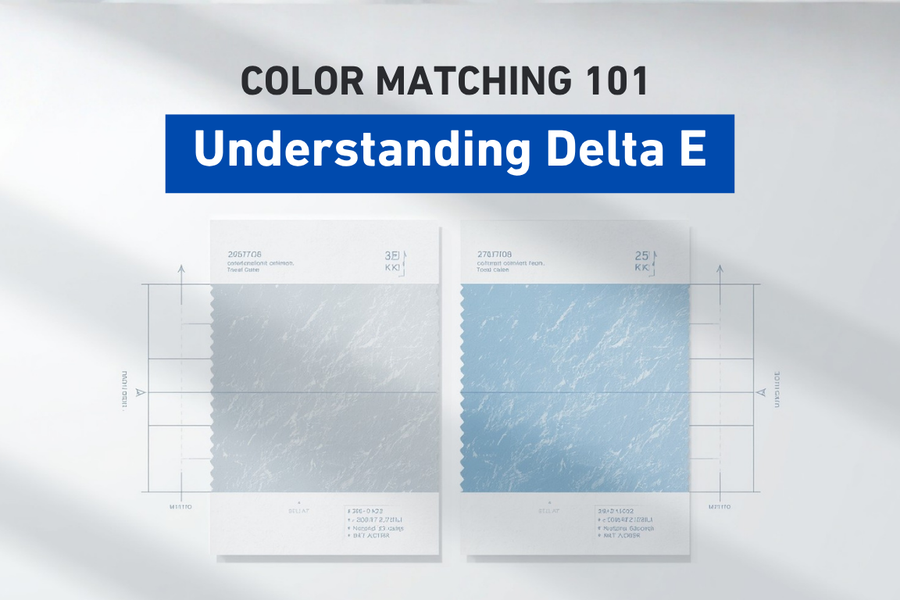
Imagine holding two prints side by side. At first glance they look identical, but something feels slightly off. Is the blue a little darker? Is the red a touch warmer? Instead of relying on human opinion, the printing industry uses a standardized measurement called Delta E to determine exactly how different two colors really are.
Can You See the Difference?
Imagine you've just finished printing a customer's logo. The colors look great, the print quality is sharp, and everything appears to match the approved proof.
The next day, however, you print the same job again, and this time something seems different.
Maybe the blue looks a little deeper. Perhaps the gray has a slight green tint. Or maybe everyone in the room has a different opinion about whether the colors match at all.
Who's right?
The truth is that our eyes aren't perfect measuring tools. For instance, lighting changes what we see, fatigue affects our perception, and even age can influence how we distinguish colors.
That's why the printing industry doesn't rely solely on visual judgment. Instead, it uses a standardized way to measure color differences. That measurement is called Delta E.
What Is Delta E?
Delta E, often written as ΔE, is a numerical value that describes the difference between two colors. Think of it as the distance between colors.
If two colors are identical, the Delta E is zero. As the number increases, however, the difference between the colors becomes more noticeable.
Rather than saying, "These colors look close," Delta E provides an objective measurement that everyone can understand. As a result, it gives printers, manufacturers, designers, and customers a common language for discussing color accuracy.
Why Our Eyes Can Be Misleading
Have you ever taken a shirt outside and noticed it looked different than it did under the lights in your home? Nothing about the shirt changed; only the lighting did.
Similarly, the same thing happens with printed graphics. For example, a print viewed under fluorescent office lights may appear slightly different under LED lighting, sunlight, or showroom lighting.
Our eyes also adapt to surrounding colors, so looking at a bright red image for several minutes can temporarily affect how we perceive other colors.
Even two people standing side by side may disagree about whether two colors match, but that doesn't mean either person is wrong. Human vision is simply subjective.
As a result, Delta E removes much of that subjectivity by providing a measurable value instead of relying on personal opinion.
How Is Delta E Measured?
To calculate Delta E, printers use an instrument called a spectrophotometer, which measures how light is reflected from a printed color.
That information is then compared to a target color, and specialized software calculates the value.
As a result, instead of guessing whether a color is acceptable, printers can make decisions based on measurable data.
We'll take a much closer look at spectrophotometers in a future episode, but for now, it's enough to know that they allow color to be measured with remarkable precision.
What Is a Good Delta E Value?
One of the most common questions in color management is, "What Delta E should I aim for?" The answer, however, depends on the application.
Generally speaking:
- ΔE below 1: The difference is nearly impossible for most people to see.
- ΔE between 1 and 2: Only a trained eye may notice a slight variation.
- ΔE between 2 and 3: Small differences become visible, but many commercial printing applications still consider this acceptable.
- ΔE above 3: Color differences become increasingly noticeable and may require adjustment depending on customer expectations.
It's important to remember that these are general guidelines, since different industries have different tolerances. For example, a luxury packaging manufacturer may require much tighter color consistency than a temporary event sign.
Why Delta E Matters
Imagine you're printing uniforms for a sports team.
Half of the order is printed today, and the other half is printed next month.
If the team colors don't match, the difference will be obvious when everyone wears the uniforms together.
The same applies to:
- Corporate branding
- Retail signage
- Product packaging
- Vehicle graphics
- Promotional products
- Interior décor
- Fine art reproduction
Customers expect consistency, even if they don't know what Delta E is.
They simply expect today's print to match yesterday's.
Delta E helps make that possible.
Delta E Isn't About Chasing Perfection
One common misconception is that every print must achieve a Delta E of zero.
In reality, that's rarely practical.
Every printing process has natural variation.
Temperature changes.
Humidity changes.
Media batches vary slightly.
Ink behaves differently over time.
The goal isn't perfection.
The goal is consistency.
Professional print shops establish acceptable tolerances that balance color accuracy with efficient production.
Rather than chasing tiny differences that no customer would ever notice, they focus on maintaining predictable, repeatable quality.
Delta E Supports Better Decision-Making
Without measurement, operators often make adjustments based on what they think they see.
Sometimes those adjustments solve the problem.
Sometimes they make it worse.
Delta E provides confidence.
Instead of asking, "Does this look right?" operators can ask, "Does this meet our target?"
That shift from opinion to measurement helps reduce unnecessary adjustments, improve repeatability, and create more stable production workflows.
Delta E Is Part of a Bigger Picture
Although Delta E is an important measurement, it isn't the only factor that influences print quality.
Accurate color also depends on:
- Proper ICC profiles
- Printer maintenance
- Consistent media
- Stable environmental conditions
- Correct RIP settings
- Well-maintained equipment
When these elements work together, Delta E becomes a valuable tool for verifying that the entire workflow is performing as expected.
Why Understanding Delta E Makes You a Better Printer
You don't need to memorize formulas or become a color scientist to benefit from Delta E.
Simply understanding that color can be measured objectively changes how you approach production.
Instead of relying only on visual judgment, you begin building workflows based on repeatability and measurable quality.
That mindset leads to fewer surprises, fewer reprints, and greater confidence in every job.
At STS Inks, we believe that successful color management combines experience with measurement. Advanced ink chemistry, reliable workflows, and consistent testing all contribute to producing repeatable results. That's why we say Color is in Our DNA.
Conclusion
Delta E gives the printing industry something incredibly valuable: an objective way to measure color.
Rather than depending entirely on human perception, printers can compare colors using standardized measurements that improve consistency across production runs, equipment, and time.
As you continue learning about color management, you'll discover that Delta E is less about finding "perfect" color and more about building confidence in your workflow.
Understanding how color is measured is another important step toward producing reliable, repeatable prints that meet customer expectations every time.
Key Takeaways
- Delta E measures the difference between two colors using a numerical value.
- Lower Delta E values indicate closer color matches.
- Human vision is subjective, while Delta E provides an objective measurement.
- Spectrophotometers are commonly used to calculate Delta E values.
- Consistent color is achieved through repeatable workflows, not by relying on visual judgment alone.
Frequently Asked Questions
What Does Delta E Mean?
Delta E is a numerical measurement that describes the difference between two colors. In other words, a lower value indicates a closer match.
Is a Perfect Zero Score Possible?
In theory, yes, since it represents two identical colors. In real-world production, however, achieving an exact zero is uncommon, and most workflows operate within acceptable tolerances.
What Instrument Measures It?
A spectrophotometer measures reflected light from a printed sample, and then it calculates the color difference compared to a target.
Why Does This Measurement Matter in Printing?
It provides an objective way to verify color accuracy, which in turn helps reduce reprints and improve consistency across production runs.
Does Every Print Job Require the Same Tolerance?
No. Acceptable tolerances vary depending on the application, customer expectations, and industry requirements.
Can I Evaluate Color Accuracy Without It?
Visual inspection remains important, but it is influenced by lighting and human perception. As a result, Delta E provides measurable data that supports more consistent decision-making.
Does Delta E Replace ICC Profiles?
No. ICC profiles manage how colors are translated between devices, while Delta E measures how closely the final printed color matches the intended target.
Quick Definitions
Delta E (ΔE): A numerical value used to measure the difference between two colors.
Spectrophotometer: An instrument that measures how light is reflected from a surface to evaluate color.
Color Tolerance: The acceptable amount of color variation for a specific application.
Repeatability: The ability to produce consistent color across multiple print runs.
Quality Control: The process of verifying that printed output meets established performance and color standards.
Next Episode
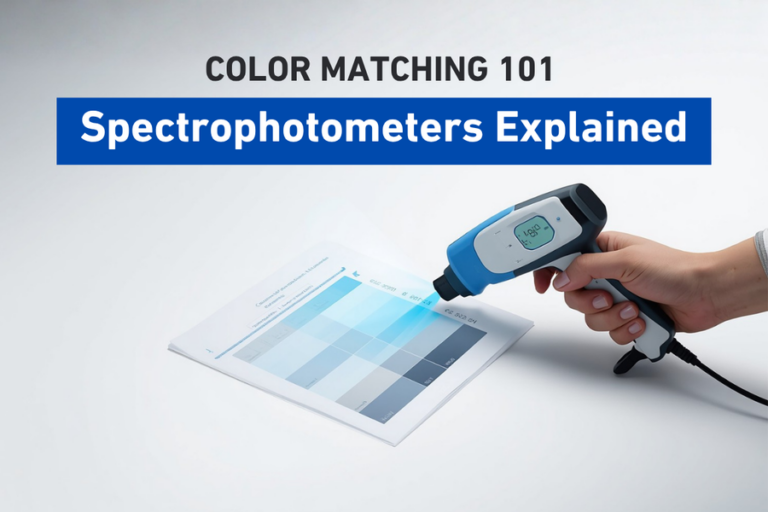
Episode 5: Spectrophotometers Explained
Now that you know how color differences are measured, it's time to meet the instrument that makes those measurements possible. In Episode 5, we'll explore how spectrophotometers work, why they're essential to professional color management, and how they help printers achieve accurate, repeatable color with confidence.